
 Türkçe
 Français
 Deutsch

The types of implants used in dentistry are primarily classified according to the anatomical region in which they are placed and the material from which they are manufactured. In current clinical practice, the most frequently used types are endosteal (in-bone) implants that are placed directly into the jawbone, subperiosteal implants that are applied beneath the periosteum in cases where bone volume is insufficient, and zygomatic (cheekbone) implants used in the upper jaw when there is advanced bone resorption. In addition, there are basic material-based distinctions such as titanium and zirconia, determined according to tissue compatibility and aesthetic expectations. Each type of implant is selected specifically according to the patient’s bone structure and the need to restore chewing function.
How Does Osseointegration, the Basis of Implant Treatment, Occur?
When we mention an implant, a screw may immediately come to mind. Yes, mechanically it resembles a screw, but biologically its function is much greater. Professor Brånemark from Sweden, regarded as the father of modern implantology, considered edentulism almost like the loss of a limb and discovered that bone tissue does not reject certain special metals such as titanium, but instead surrounds and incorporates them. We call this remarkable biological process “osseointegration.”
This process is not as simple as a screw being driven into a piece of wood. It is the migration of living bone cells to the surface of the artificial root we place, their proliferation there, and over time making the implant an integral part of the bone. This integration is so strong that once healing is complete, the implant can withstand hundreds of kilograms of chewing force just like your natural tooth. However, it is not possible to achieve this success by using the same “standard” screw for every patient. Factors such as the patient’s bone quality, age, aesthetic expectations and systemic diseases directly determine the type of implant we will use.
Which Types of Endosteal Implants Are Most Commonly Preferred?
When you visit a dental clinic today, the type of implant that will be recommended to you with a 90% probability is the “endosteal,” that is, in-bone implant. These are structures in the form of cylinders or screws designed to mimic the natural tooth root. They are placed into the jawbone (alveolar bone), either in the socket where your tooth root previously resided or in healed bone tissue.
The greatest advantage of these implants is that they are supported by decades of scientific data and clinical success stories. We can safely use them both to replace a single missing tooth and to restore the entire mouth. However, there is one indispensable requirement for placing these implants: sufficient bone volume. We need healthy bone tissue that will surround the implant and hold it firmly in place.
The most common forms of these implants are:
- Screw-type implants
- Cylindrical implants
- Blade implants (now rarely used)
Which Types of Implants Are Suitable for Patients with Severe Bone Loss?
Sometimes when our patients come to the clinic, we see that they lost their teeth a very long time ago. Unfortunately, years spent without teeth result in resorption and thinning of the jawbone. In such cases, there may no longer be sufficient width or height of bone to place a standard implant. In the past, these patients were often told, “You cannot have implants, you have to use a removable denture.” Today, however, thanks to technology, we can provide fixed teeth even in cases that were once considered “impossible.”
This is where subperiosteal implants come into play. In this method, a special framework is placed not inside the bone but on top of the bone, under the gum tissue. In the past, this technique was very difficult to perform, but today it has been reborn with digital dentistry. Using computed tomography, we obtain an exact copy of the patient’s jawbone and produce custom-made titanium frameworks with 3D printers. This framework sits on the bone like a glove, and we attach the teeth onto it.
In addition, for cases in the upper jaw where the sinus cavities have dropped and the bone has completely resorbed, we have very special, long implants. The best known of these are “zygomatic” implants. These implants bypass the resorbed bone inside the mouth and anchor directly into the zygomatic bone (cheekbone). Because the cheekbone has a very hard and dense structure, the implant can integrate there extremely securely.
The advantages of these advanced surgical methods are:
- No need for bone grafting
- Shortened treatment time
- Possibility of fixed prostheses
- High success rate
Which Is Better for Material Selection: Titanium or Zirconia Implants?
One of the most frequent questions my patients ask is, “Doctor, what should the brand or material of the implant be?” For many years, the gold standard in implantology has been the element “titanium.” Titanium is a metal that is highly compatible with the body, lightweight yet stronger than steel. Its resistance to fracture is very high and its long-term success has been well established.
However, in recent years, with increasing aesthetic expectations and rare situations such as metal allergies coming into focus, “zirconia” implants have gained popularity. Zirconia is not actually a metal, but a very strong ceramic. Its color is white, which makes it an aesthetic savior especially in the front teeth and in cases where the gum tissue is thin. It completely eliminates the risk of a gray shine from titanium.
Even more importantly, zirconia’s relationship with the gum tissue is excellent. The gums “like” zirconia; less plaque accumulates around this material and the risk of gum inflammation is lower compared to titanium. It shows outstanding biological compatibility.
Mechanically, however, titanium still has a slight advantage. Titanium is elastic, meaning it can micro-flex under chewing forces and distribute the load to the bone. Zirconia, on the other hand, is very hard but more brittle. Under excessive load, instead of flexing it has a (still low, but higher than titanium) risk of fracture.
The selection criteria between these two materials are:
- Aesthetic expectations
- Thickness of the gum tissue
- The patient’s chewing force
- Presence of metal allergy
- Parafunctional habits (such as teeth grinding)
How Do the Surface Characteristics and Design of an Implant Affect Healing?
When you hold an implant in your hand, you might think it is just a simple screw. However, the microscopic details on the surface of that screw are the true secret of success. Manufacturers apply special processes such as sandblasting and acid-etching to roughen the implant surface. Why? Because bone cells cannot adhere to a smooth, slippery surface. The rougher and more irregular the surface, the better the cells can settle into these micro-spaces and form a tighter bond with the bone.
The latest technology has brought us “hydrophilic” surfaces that are water-loving. Normally, metals can repel water, but these special surfaces absorb blood like a sponge the moment they come into contact with it and spread it across the surface. This dramatically accelerates the healing process. Especially in diabetic patients or individuals with low healing potential, we prefer implants with such smart surfaces.
The “macro design” of the implant, meaning the shape of its threads, is also critical. Some implants are cylindrical, while others are tapered, narrowing towards the tip like a natural tooth root. Tapered implants compress the bone slightly as they are placed, thereby providing very high primary stability. If I plan to place a tooth for my patient on the same day as the implant, I usually prefer these more aggressive, high-compression, tapered implants.
The advantages provided by surface and design features are:
- Faster healing process
- Possibility of immediate or early loading
- High bone anchorage
- Reduced risk of infection
For Which Patients Are Narrow-Diameter and Mini Implants Used?
Not every patient’s jawbone is wide enough to accommodate a standard-sized implant. Especially in the anterior region of the lower jaw or in situations where the teeth are very close to each other, “narrow-diameter implants” can be lifesaving. With diameters generally ranging between 3.3 mm and 3.5 mm, these implants offer a safe solution even in thin bones. Their durability has been significantly increased with modern alloys (such as titanium–zirconia combinations).
There are also “mini implants,” which are much thinner (under 3 mm). We typically do not use mini implants to support fixed porcelain teeth but rather to stabilize removable dentures for our elderly patients. Imagine a patient whose denture has been moving around in their mouth for years, making eating difficult, and who is not fit for major surgery or bone grafting procedures. In such cases, we can place these mini implants in just a few minutes, sometimes without even making an incision in the gum, and then attach their existing denture to these implants like a snap fastener. This provides an immediate improvement in quality of life and is an economical, practical solution.
The indications for mini implants include:
- Stabilization of removable dentures
- Support for temporary prostheses
- Orthodontic anchorage
- Narrow tooth spaces
How Are Surgical Techniques and the Timing of Tooth Placement Determined?
One of the questions my patients are most curious about is, “When will I be able to use my teeth?” Here, we can follow two different surgical paths. In the traditional method, we place the implant into the bone and completely cover it with gum tissue. The implant then remains in a kind of “sleep mode,” isolated from the oral environment, while it fuses with the bone. After 3–4 months, we perform a small procedure to uncover it and begin making the tooth. This is called “two-stage surgery” and is usually preferred in cases where we have added bone grafts or consider the situation risky.
Nowadays, however, we know that our patients want fast solutions so as not to be cut off from social life. Therefore, “one-stage surgery” and “immediate loading” protocols have become very common. If the bone quality is good and, when we place the implant, its insertion torque (the holding force in the bone) is high, we can place temporary fixed teeth for the patient on the same day or within 48 hours.
Immediate loading is a wonderful method that eliminates the fear of being left without teeth. However, it is not suitable for every patient. In cases where the bone is soft, rushing can lead to implant failure. At this point, trusting your dentist’s experience and measurements is crucial. Sometimes choosing the traditional method with the mindset of “better safe than sorry” is the wisest path for avoiding problems in the long term.
The loading protocols are:
- Immediate loading (within the first 48 hours)
- Early loading (between 1 week and 2 months)
- Delayed loading (3 months and beyond)
What Are the Types of Prostheses Placed on Implants and How Do They Differ in Use?
Implant treatment is not only about placing screws into the bone; the real comfort is determined by the prosthesis that will be made on top of those screws. Basically, we have two main options: fixed prostheses and removable prostheses.
Fixed prostheses are porcelain or zirconia teeth that the patient cannot remove and that feel like their own natural teeth. These are divided into two categories: “screw-retained” and “cement-retained.” As dentists, we have come to prefer screw-retained systems more in recent years. Why? Because screw-retained crowns have a small, invisible access hole. If a problem occurs in the gum or a fracture develops in the porcelain in the future, we can loosen the screw, remove the prosthesis without damaging it, repair it and screw it back into place. In cement-retained systems, however, the prosthesis may sometimes have to be cut to be removed, and residual cement can lead to gum infections.
Removable prostheses (overdentures) are prostheses we use in completely edentulous mouths and that the patient can remove and clean themselves. They are ideal for patients who already use full dentures that tend to move or fall while talking and eating. Two to four implants are placed in the jaw, and special attachments (bars or ball attachments) that match these implants are embedded inside the prosthesis. When the prosthesis is placed in the mouth, it snaps into place with a “click” and does not move. They are easy to clean and, by supporting the lips, help erase the aged facial appearance.
The factors that determine the type of prosthesis are:
- Number of implants
- Bone support
- Aesthetic needs
- The patient’s manual dexterity
- Economic situation
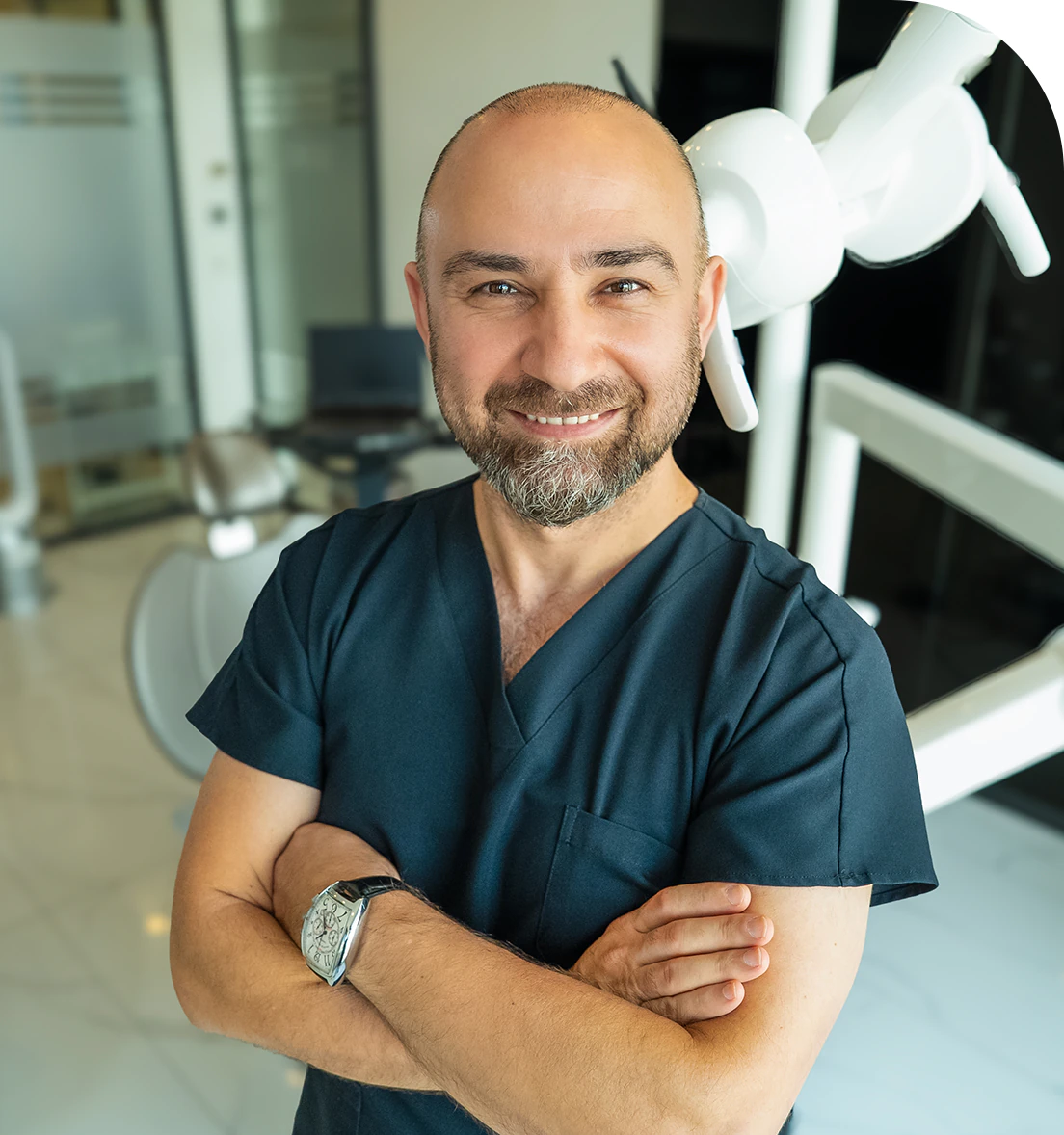
Dr. Dt. Ömer Atar provides care at his private clinic in Istanbul, combining his academic background and many years of clinical experience in dentistry. With a treatment approach that integrates aesthetic and functional solutions, he aims to achieve natural, balanced, and long-lasting results through personalized planning for each patient. Dr. Atar completed his education at the Marmara University Faculty of Dentistry, which he began in 1994, graduating in 2000. He continued his academic work in the Department of Prosthodontics at the same university. In 2007, he earned his PhD degree with his scientific thesis on implants and implant-supported prostheses in patients undergoing distraction osteogenesis. His academic expertise deepened in the fields of metal-free aesthetic systems, implant-supported prostheses, and cosmetic dentistry. Integrating modern technologies and digital dentistry into his practice, Dr. Ömer Atar achieves high success rates in treatments such as smile design, All-on-4/All-on-6 implant treatments, laminate veneers, zirconium crowns, teeth whitening, and gingival aesthetics (gummy smile). As a member of EDAD (Turkish Academy of Aesthetic Dentistry), he embraces a holistic approach focused on modern, functional, and natural outcomes in aesthetic dentistry.


