
 Türkçe
 Français
 Deutsch
 Nederlands
 Svenska

It is possible and quite common to apply zirconia crowns only to the front teeth. The high light transmittance of zirconia provides results that are very close to the natural appearance of teeth. Thanks to this property, it is especially preferred for front teeth in cases where smile aesthetics are targeted.
Due to their aesthetic advantages, zirconia crowns are used in the restoration of discolored, misshapen, or spaced front teeth. Because their biological compatibility with the gums is high, the risk of discoloration or recession at the gum margin is minimal. The results are long-lasting and aesthetic.
Zirconia applications on the front teeth are planned according to the patient’s jaw structure and smile line. With proper planning, a natural smile can be achieved by crowning only 4–6 front teeth. During this process, the symmetry, color, and dimensions of the teeth are carefully evaluated.
Since chewing forces are lower on the front teeth compared to the back teeth, the durability of zirconia is more than sufficient in this area. However, if habits such as teeth grinding exist, the dentist evaluates suitability. In necessary cases, the use of a night guard may be recommended.
What is a zirconia crown?
A zirconia crown is a type of dental crown placed over the teeth and consisting of a durable ceramic with a substructure made of zirconia oxide. Since it does not contain metal, its light transmittance is higher, which gives the tooth a more natural appearance. This is precisely why it is preferred, especially in the front tooth region, where aesthetic expectations are at the forefront.
Zirconia stands out not only in terms of aesthetics but also in terms of biocompatibility. Its compatibility with the gums is generally good, and the risk of allergic reactions is considered low. However, suitability must always be evaluated individually for each patient.
Can zirconia crowns be applied only to front teeth?
Yes, zirconia crowns can be applied only to the front teeth. This is a situation frequently encountered in clinical practice. Especially the upper front teeth located within the smile line are more visible aesthetically, so the need for crowns often concentrates in this region.
Some patients complain only about discoloration in a single tooth, while others think that several front teeth have shape or alignment problems. In such cases, instead of a procedure covering all teeth, crowns can be planned only for the front teeth that are needed. The important point here is that the teeth to be crowned are compatible in color and form with the neighboring teeth.
In which situations are zirconia crowns considered for front teeth?
Applying zirconia crowns to the front teeth is generally associated with aesthetic expectations. However, not every aesthetic concern requires a crown. The dentist makes a decision by evaluating different treatment options.
Some situations in which zirconia crowns on the front teeth may be considered include:
- Advanced discolorations that cannot be eliminated with teeth whitening
- Old and aesthetically inadequate fillings on the front teeth
- Broken, worn, or misshapen teeth
- Cases where closure of tooth gaps (diastema) is desired
- Previously applied metal-supported crowns that are aesthetically disturbing
In such cases, zirconia crowns may be considered as an option. However, the final decision is made in line with the current condition of the tooth, gum health, and the patient’s expectations.
Advantages of applying crowns only to the front teeth
Applying zirconia crowns only to the front teeth offers a more controlled and targeted approach for some patients. The most obvious advantage is that aesthetic improvement is achieved directly in the smile line. The person may feel that they have achieved a more balanced and natural-looking smile in a short time.
In addition, performing procedures on a more limited number of teeth may cause the planning and application process to take less time. This may be a reason for preference, especially for people with a busy lifestyle. However, which teeth are considered “front teeth” may vary depending on the person’s smile pattern. In some people, the side teeth also become visible when smiling, and the planning may be expanded accordingly.
What should be considered when applying zirconia crowns on front teeth?
The front teeth are the most sensitive area aesthetically. For this reason, certain points are especially important when planning zirconia crowns. Color selection, crown thickness, and compatibility with the gums directly affect the outcome.
When determining the color, not only the shade desired by the patient but also skin tone, lip structure, and the color of neighboring teeth are taken into account. An overly white crown may create an artificial appearance if it does not harmonize with natural teeth. Therefore, the goal is not to achieve the “whitest” but the “most compatible” color.
In addition, gum health is closely monitored in crowns applied to the front teeth. If there are problems such as gum recession or inflammation, these issues may need to be addressed before crowning. Crowns remain compatible for a longer time when placed on a healthy gum foundation.
Are zirconia crowns on front teeth suitable for everyone?
Although zirconia crowns are a suitable option for many people, it cannot be said that they are ideal for everyone. For example, in individuals with habits such as teeth grinding or clenching, the load on the crowns may be greater. In this case, additional precautions may be required.
Furthermore, if the tooth structure has suffered significant material loss or if the gum level is irregular, different treatment options may come into consideration. Sometimes bonding applications, porcelain laminates, or orthodontic solutions may be found more suitable. Therefore, it is important for individuals who want an aesthetic change in their front teeth to evaluate all alternatives together with their dentist.
How does the treatment process progress?
The zirconia crown process for the front teeth generally consists of several stages. During the initial examination, the teeth are evaluated in detail and the patient’s expectations are listened to. If deemed necessary, impressions are taken and temporary crowns may be prepared.
In the laboratory phase, custom-made crowns are designed for the patient. During this process, the form, length, and color of the tooth are determined meticulously. In the final stage, the crowns are fitted to the teeth and necessary checks are performed. All of these stages may vary depending on the individual and the planning.
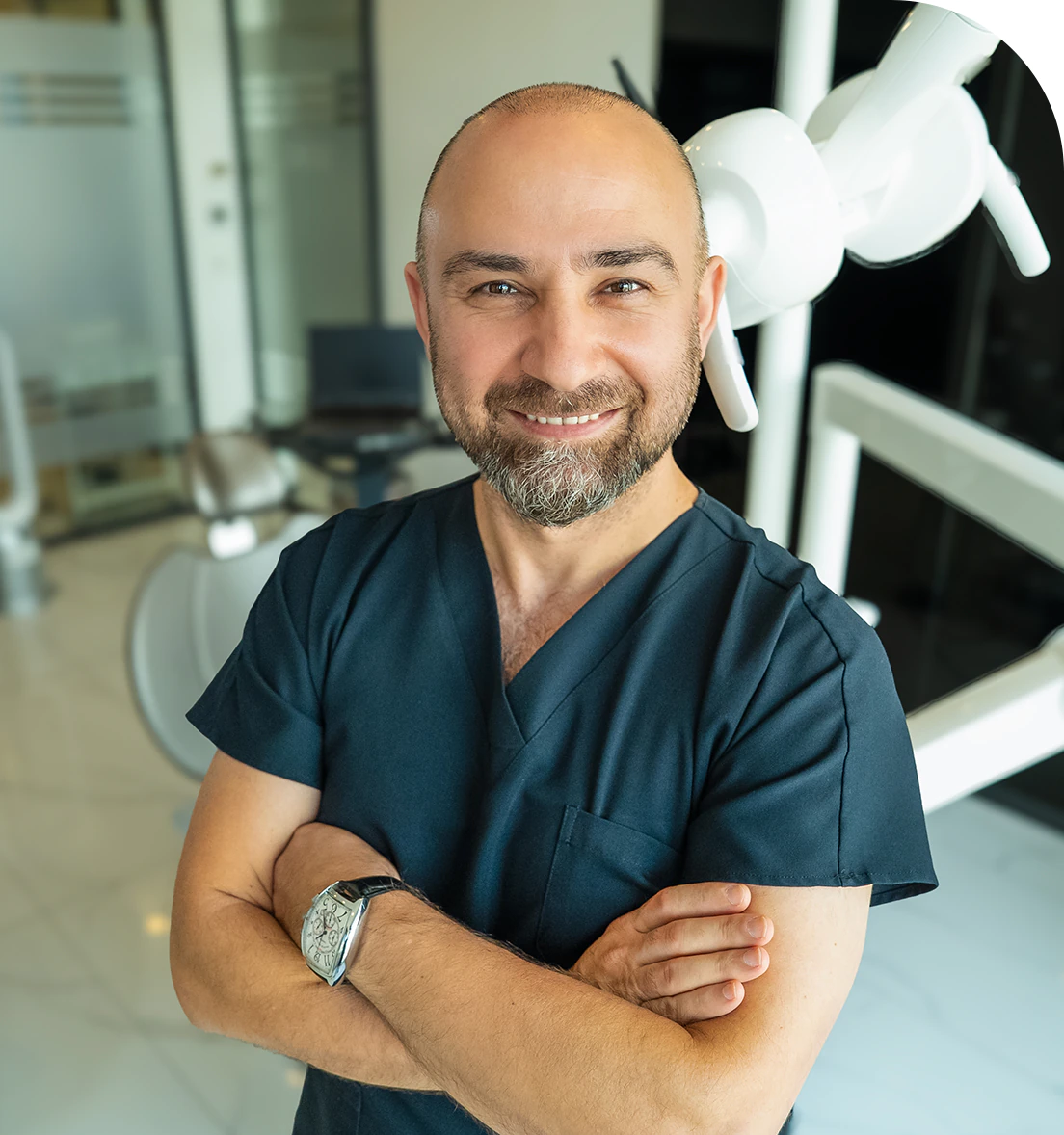
Dr. Dt. Ömer Atar provides care at his private clinic in Istanbul, combining his academic background and many years of clinical experience in dentistry. With a treatment approach that integrates aesthetic and functional solutions, he aims to achieve natural, balanced, and long-lasting results through personalized planning for each patient. Dr. Atar completed his education at the Marmara University Faculty of Dentistry, which he began in 1994, graduating in 2000. He continued his academic work in the Department of Prosthodontics at the same university. In 2007, he earned his PhD degree with his scientific thesis on implants and implant-supported prostheses in patients undergoing distraction osteogenesis. His academic expertise deepened in the fields of metal-free aesthetic systems, implant-supported prostheses, and cosmetic dentistry. Integrating modern technologies and digital dentistry into his practice, Dr. Ömer Atar achieves high success rates in treatments such as smile design, All-on-4/All-on-6 implant treatments, laminate veneers, zirconium crowns, teeth whitening, and gingival aesthetics (gummy smile). As a member of EDAD (Turkish Academy of Aesthetic Dentistry), he embraces a holistic approach focused on modern, functional, and natural outcomes in aesthetic dentistry.


